
Mapping the Expression of Genius

What if you could find a map for flow?! One that helped you map the expression of your Genius! It's HERE!
Two Wings. One Flight. Every Day.
Finding Your Genius in the Tension You Thought Was A Problem with the EDG Butterfly Map
It's a Dynamic Imprint. It maps the Tension of your Genius. Not a tension to fight, but one that inspires flow!
One of the most powerful tools I use is the EDG Butterfly Map. It is foundational for everything I do.
The reason it is so effective is because it is orientational. Using it allows me to help my clients see where Genius is active already in their lives and also where it gets stopped up, from limiting beliefs and from the environments we find ourselves in that don't always seem to allow for its full expression.
The EDG Butterfly Map: What is it?
It is an original framework — part self-discovery tool, part organizational philosophy, wrapped in a butterfly metaphor that actually holds together conceptually. It was born of the idea that tension between opposites is the source of flight rather than a problem to eliminate.
It takes what was a drain of energy and makes it generative.
Who's it For
The EDG Butterfly Map begins with the individual, but it doesn't stop there. This work finds its home in college and university settings, businesses, associations, and nonprofits — wherever leaders are willing to ask what becomes possible when every person in the room knows how to fly. What's possible when we focus on each individual Genius in the room.
How it Works - Visually
The EDG Butterfly Map allows us to see the ways we tend to compartmentalize one side of a paradox and set it against the other. Both sides are assumed to be positive, whereas in our normal framing one side has been labeled positive, the other negative, creating resistance. The map also represents their potential downsides, not as failures, but as signals. Instead of either/or, we adopt a both/and, with signs and signals indicating when we need to move rather than dig in and get stuck.
This paradox is mapped on two wings — upper sections in teal representing the two sides meant to work together like yin and yang, and lower sections in amber representing the effects of compulsive focus on one side at the expense of the other.
The butterfly's body is its fulcrum — the source of power activated when Genius learns to loop through each wing, residing mostly in the upper wings while recognizing the pull of overdependence in the lower. At the center of the body is the EDG Point, also called the crossing point — meant to be a throughway, but often where we make hard right-angle turns that lead to stagnation or burnout. When we learn to move through it naturally, full flight becomes possible
The Core Idea: Eight Genius Tensions
The map works with eight genius tensions, not as stress but as pull, tension used correctly creating a path of least resistance. Each Genius Tension or Imprint is a paradox we navigate and a polarity to move through, not a problem to solve, but.
- Certainty ↔ Wonder
- Giving ↔ Receiving
- Visibility ↔ Solitude
- Structure ↔ Flow
- Gratitude ↔ Vision
- Doubt ↔ Confidence
- Resistance ↔ Momentum
- Inner Fire ↔ Outer Reward
Each of these represent expressions of Genius and they all exist in all of us. What I found, however is that sometimes, our life presents as dominant in one area or another. For that I created the Genius Imprint Assessment. It's an orientation, not a personality profile or type. It's an entry into the language and landscape of the EDG Butterfly Map.
When we view tension correctly in these paradoxical systems, problems resolve themselves. We no longer fight. We flow.
This same tension also exists in character strengths, though it had never been mapped this way until I created the EDG Butterfly Map. I specifically use the VIA Character Strengths as foundational in coaching sessions and workshops because they apply across all domains of life, not just the workplace.
Mapping the VIA Strengths
I have deepened the work with the 24 VIA Strengths by expanding on the existing framework which was, until now - underuse <- Strength -> overuse - by centering each Strength in the Butterfly's body, placing the overuse and underuse in the amber wings, and creating the terminology for the positive aspects and expression of overuse and underuse, residing in the teal wings.
For example, the Strength of Curiosity was
disengagement <- Curiosity -> Nosiness
and has now become
(+Wonder | - disengagement <- Curiosity -> + Inquiry | - Nosiness).
The polarities of Curiosity have been adequately mapped with the positive internal and external expressions in the teal wings, and the underuse - internal focus and overuse - external focus in the amber wings.
See photo example below of Curiosity mapped.
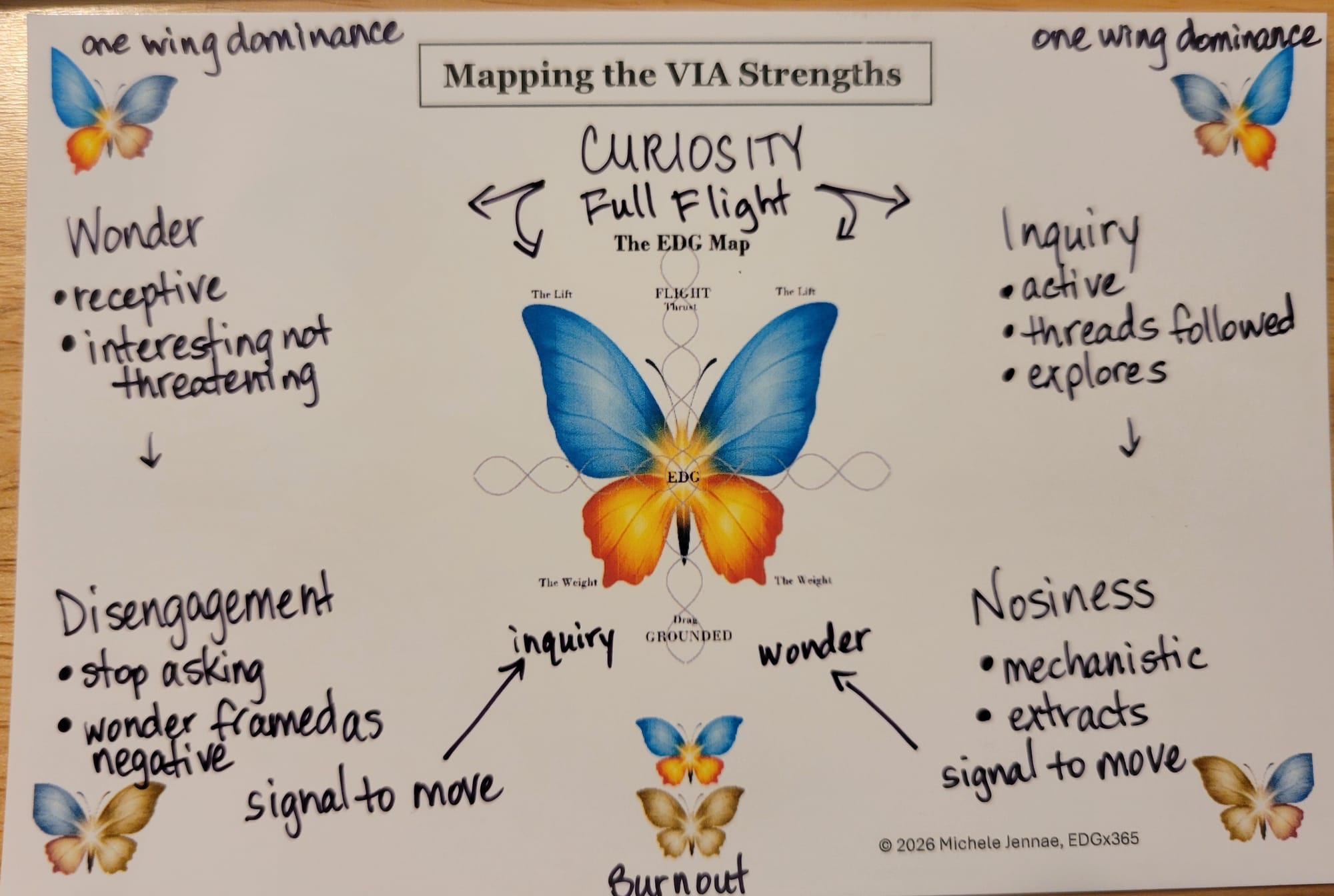
Curiosity in full flight moves between the teal wings naturally as the amber wing symptoms are recognized and the realization of choice to embrace the opposite becomes apparent and available.
The EDG Butterfly Map becomes a bridge between who you are and how you move. It takes resistance and turns it into acceptance, embrace, and full expression.
The direct inspiration is a four-quadrant polarity map presented by Barry Johnson, whose work is largely focused on organizational polarities. The EDG Butterfly Map differs in vocabulary, visual form, unit of analysis, and philosophical framing — where Johnson works at the organizational level, the EDG Butterfly Map works with the paradox of being human across every domain of life. It does not manage tension. It makes it navigable.
Experience it for Yourself
Take the Genius Imprint Assessment
Map Your Genius
Every Day Genius x 365 | EDGx365 | Not more IQ; MORE YOU!
 Michele Jennae
See also the free TWO WINGS eBook for an expanded look at the EDG Butterfly Map.
Two Wings eBook
You don’t need to find yourself. You’re already here. Two Wings introduces the EDG Map — a framework built on butterfly flight science that shows you why the tension you’ve been managing privately is actually the architecture of your genius.
Michele Jennae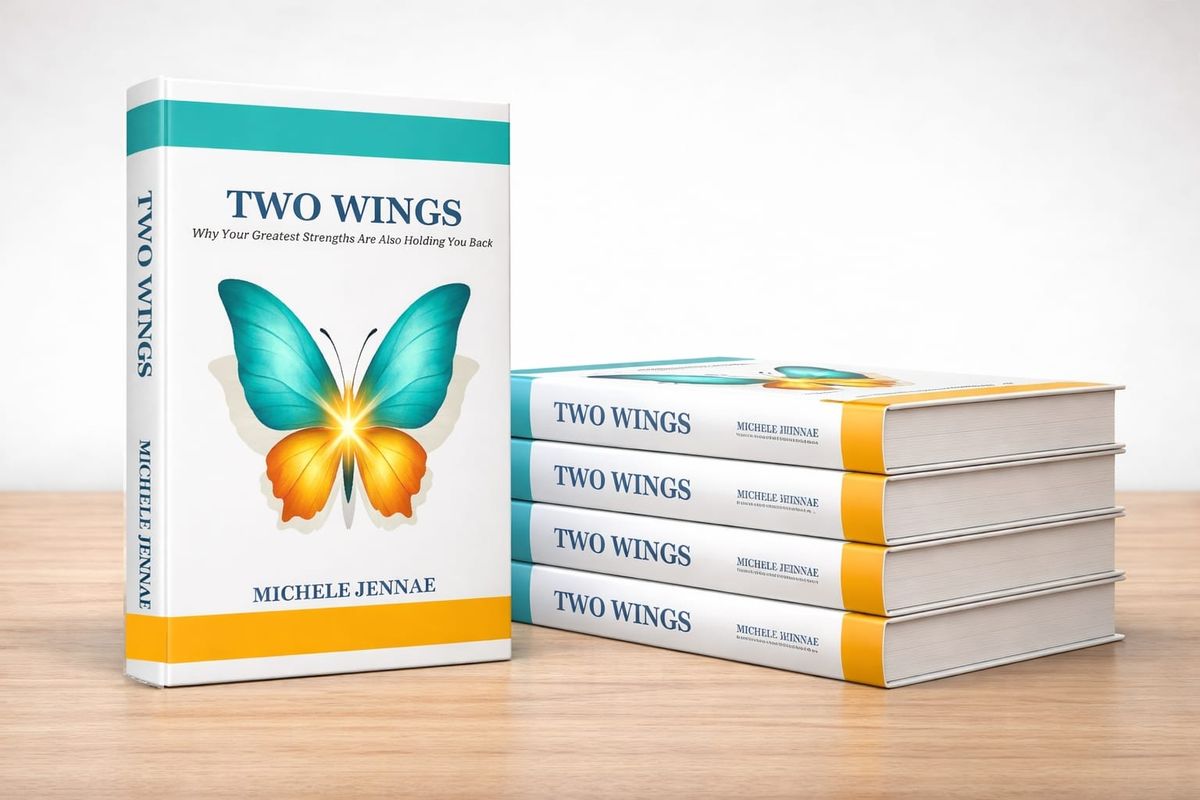
Get the Weekly Genius Update
Curated so your inbox is Genius too!











Member discussion