
The EDG Butterfly Map

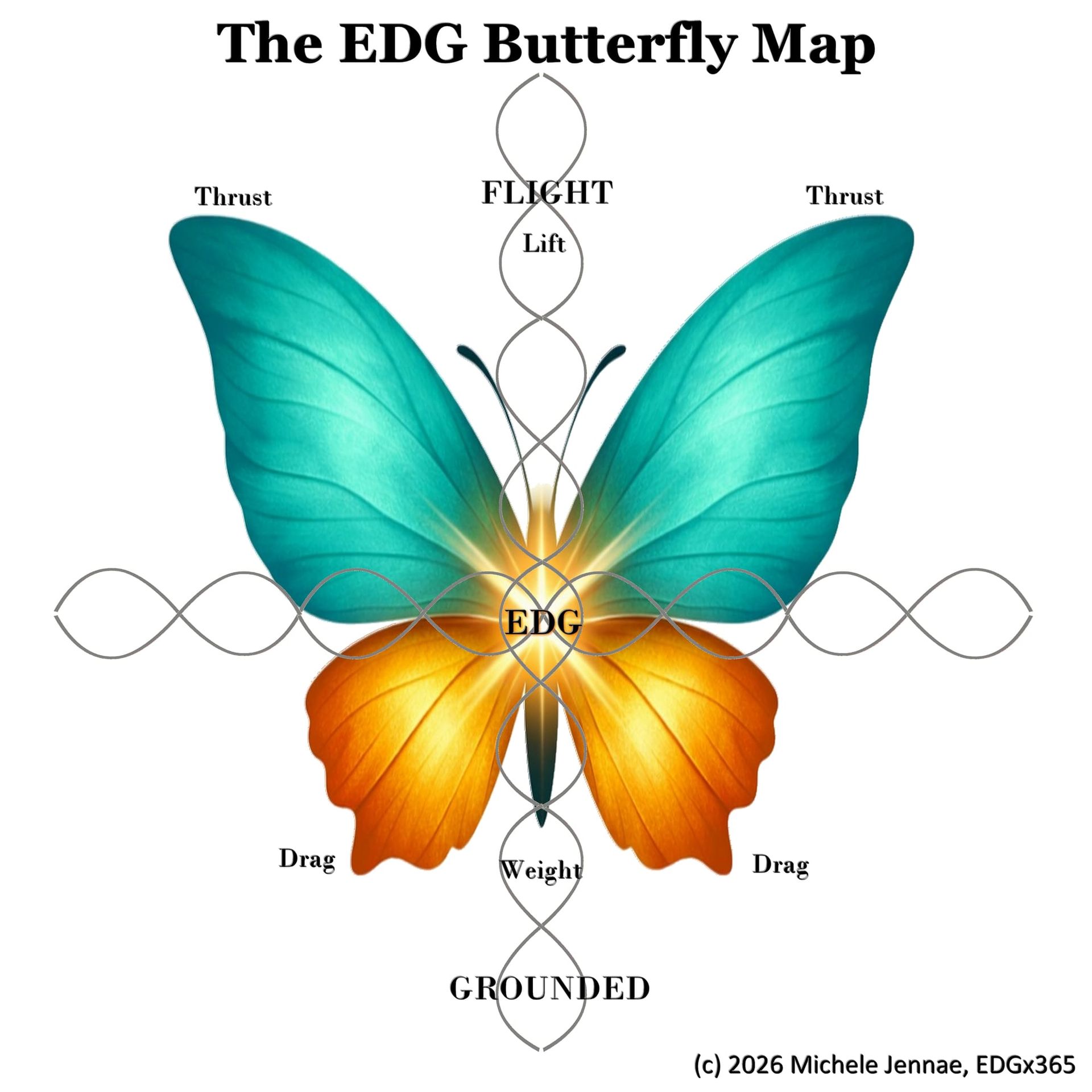
Michele Jennae has created a way to map the living circuitry of your Genius in Expression. There is Genius in every room. Yours included.
What is the EDG Butterfly Map?
The EDG Butterfly Map (©2026) is the underlying blueprint for my work at Every Day Genius. I created it in an attempt to understand much of what I had struggled with my entire life, and what I saw as patterns beyond myself — patterns present in all of us.
Its direct inspiration is a four-quadrant polarity map presented and popularized by Barry Johnson, whose work is largely focused on organizational polarities. The EDG Butterfly Map differs from Johnson's Polarity Map® in vocabulary, visual form, unit of analysis, and philosophical framing. Where Johnson works at the organizational level, the EDG Butterfly Map works with the paradox of being human — across every domain of life. It does not manage tension. It makes it navigable.
At the core of everything is one foundational assumption: you are already a Genius. The map exists to help you see that — and to see how you move.
Reading the Map
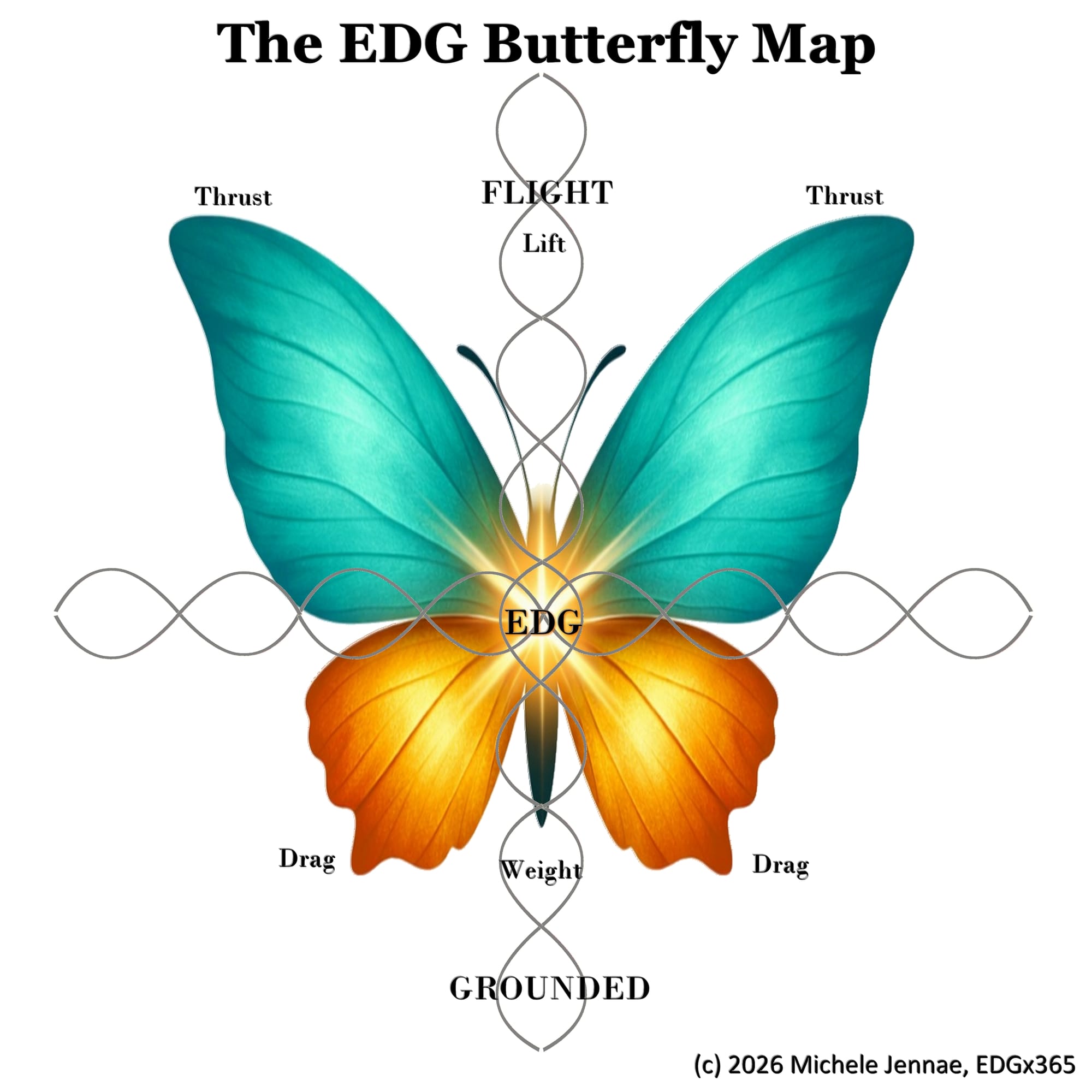
The butterfly is not just a metaphor. Its parts represent a holistic blueprint of an active, living circuit — what I call the Genius in Full Flight, the optimal expression of who you are.
The Upper Wings (Teal) — The two sides of each tension meant to work together, like yin and yang. Neither is better. Both are necessary. These are where Genius lives most of the time.
The Lower Wings (Amber) — What happens when you compulsively favor one side of a polarity at the expense of the other. Not a flaw — a signal.
The Body — The fulcrum. The source of power activated when Genius learns to loop through each wing — residing mostly in the upper wings while recognizing the pull of overdependence in the lower.
The EDG Point — The center of the body. Meant to be a throughway, it’s often where we make hard right-angle turns that lead to stagnation or burnout. When we learn to move through it naturally, that’s when full flight becomes possible.
The Eight Genius Tensions
Each tension is a paradox we navigate — not a problem to solve, but a polarity to move through. The map works with eight:
Certainty ↔ Wonder — The pull between what we know and the willingness to not know — where conviction and curiosity keep each other honest.
Giving ↔ Receiving — The circuit of exchange. When one side shuts down, generosity either depletes or closes off.
Visibility ↔ Solitude — How we show up and how we restore. Neither performance nor retreat is sustainable alone.
Structure ↔ Flow — The tension between the container and what it holds. Plans are not the enemy of creativity — rigidity is.
Gratitude ↔ Vision — Being here and reaching forward. The genius who can hold both lives in a permanent state of enough and not yet.
Doubt ↔ Confidence — Not a weakness to overcome. Doubt, in motion, is discernment. Confidence, in motion, is momentum.
Resistance ↔ Momentum — The friction before flight. Resistance is not the opposite of movement — it’s often what makes movement mean something.
Inner Fire ↔ Outer Reward — Why you do the work versus what the work earns. When these fall out of alignment, burnout follows.
These tensions also map naturally to the VIA Character Strengths, offering a bridge between who you are and how you move.
How the Map Works
The map allows us to see the ways we tend to compartmentalize one side of a paradox and set it against the other. Both sides are assumed to be positive — but the map also represents their potential downsides. Instead of either/or, we adopt a both/and, with signs and signals indicating when we need to move rather than dig in.
Genius is idiosyncratic. Personal. In a world that has conditioned us to forget ourselves in favor of a consensus self — where everyone begins to look the same while naturally fighting against it — the EDG Butterfly Map becomes the visual reference where we can learn to see ourselves again, as the whole Genius we have always been.
Beyond the Individual
While the EDG Butterfly Map begins with the individual, it doesn’t stop there. Organizations are full of individuals — and when the people inside a system understand their own genius, the entire system moves differently.
This work finds its home in college and university settings, businesses, associations, and nonprofits — wherever leaders are willing to ask what becomes possible when every person in the room knows how to fly.
The Art of Genius
The EDG Butterfly Map is also the foundation for a growing body of creative practice called the Art of Genius. Drawing on doodling, visual journaling, and what I’ve come to call “innergenic” expression, this approach uses mark-making and imagery as a non-verbal way to work directly with your genius tensions — bypassing the critic and getting to what’s actually true.
You don’t need to be an artist. You need to be willing to pick up a pen.
More on the Art of Genius: The Art of Genius (post)
Ready to See Your Map?
The Genius Imprint Assessment maps your personal pattern across the eight tensions — giving you a visual reference point for where you’re flying, where you’re stalling, and where your next movement lives.
Take the assessment: Genius Imprint Assessment
Read more: All EDG Butterfly Map posts