
The Choice That Felt Both Right and Wrong


There's something about choices that aren't always "just right." But maybe they're the best in the end...
Today I was given three choices
and told to pick from my gut.
I did. And the one I chose felt both right and wrong at the same time.
It wasn't the one I would have normally picked, but I picked it anyway. And I've been thinking about why.
Not Quite a Goldilocks Story
Here's what I noticed when I looked back at all three options:
The first one felt entirely right. This was the Goldilocks choice.
Clean. Easy. No friction. And I realized afterward, that that's exactly why I didn't choose it, even though honestly, I was inclined to. I recognized familiarity in the ease of that choice. It was the version of me that already exists making a safe, predictable move. There wasn't anything wrong with it, but nothing growing in it either. That choice would have kept the map exactly where it is.
The third one didn't move me at all. No charge, no pull, no tension. When there's no live wire, there's no EDG to follow. Easy to set aside.
But the second one, the one I chose in the end, had a particular discomfort to it. It felt both right and wrong. And that specific texture made me stop and ask myself a question I've come to recognize as important:
Is this wrong? Or is this resistance?
Because those are not the same thing. And learning to tell them apart might be the most practical skill the EDG Butterfly Map has to offer.
What the Crossing Point Actually Is
In the figure eight of the Butterfly Map, the crossing point is the narrowest place in the shape — the place where everything passes through. It's not a stop sign. It's a handoff point. The place where one wing's momentum becomes the other wing's launch.
In a sine wave, the crossing point isn't the top or the bottom. It's the middle. The moment of transition between one direction and the next. And it's not where energy dies. It's where energy concentrates. It's where direction hasn't yet been committed, which means all of it is still available.
We tend to think of the crossroads as the hard part. A place to pause, deliberate, potentially get it wrong. But the word decision comes from the Latin decidere — to cut. Not to agonize. To cut cleanly, with intention, and move.
The crossing point is the moment before the cut. And it's alive.
The Wing Fold
What I felt today — choosing the option that made me uncomfortable instead of the option that felt entirely safe — I'd call a wing fold. It's the moment you recognize a signal in the discomfort and cross over to the other teal wing anyway.
It doesn't require knowing exactly which quadrant you're in. It doesn't require a map in your hand. It requires one thing: the ability to ask yourself whether what you're feeling is a warning or a wall.
A warning says: this is genuinely not the right direction. Pay attention.
A wall says: this is unfamiliar. You'll have to stretch. You might have to go over.
Both feel uncomfortable. The difference is what lives on the other side.
Not all wrong-feeling choices are growth edges. But all growth edges feel wrong.
None of the three choices today were earth-shattering. None were life or financial dependent. And yet I sat with them long enough to second-guess myself, to feel the pull of the safe option, and to ultimately choose the one that pushed me into liminal space.
That's the crossing point in practice. Not in dramatic, everything-on-the-line decisions. In the small ones. The daily ones. The moment-to-moment ones. It's in the choices that seem ordinary but are quietly expanding — or quietly contracting — the comfort zone.
I chose the one that asked something of me. And I felt my wing unfold as I crossed to the other side.
That's the whole practice, really.
— Michele Jennae
The EDG Point, or crossing point is part of the EDG Butterfly Map, a framework for finding what your Genius Imprint is and how to learn to embrace the tension that has stopped you and let it propel you forward.
Learn more in the FREE eBook Two Wings.
Two Wings eBook
You don’t need to find yourself. You’re already here. Two Wings introduces the EDG Map — a framework built on butterfly flight science that shows you why the tension you’ve been managing privately is actually the architecture of your genius.
 Michele Jennae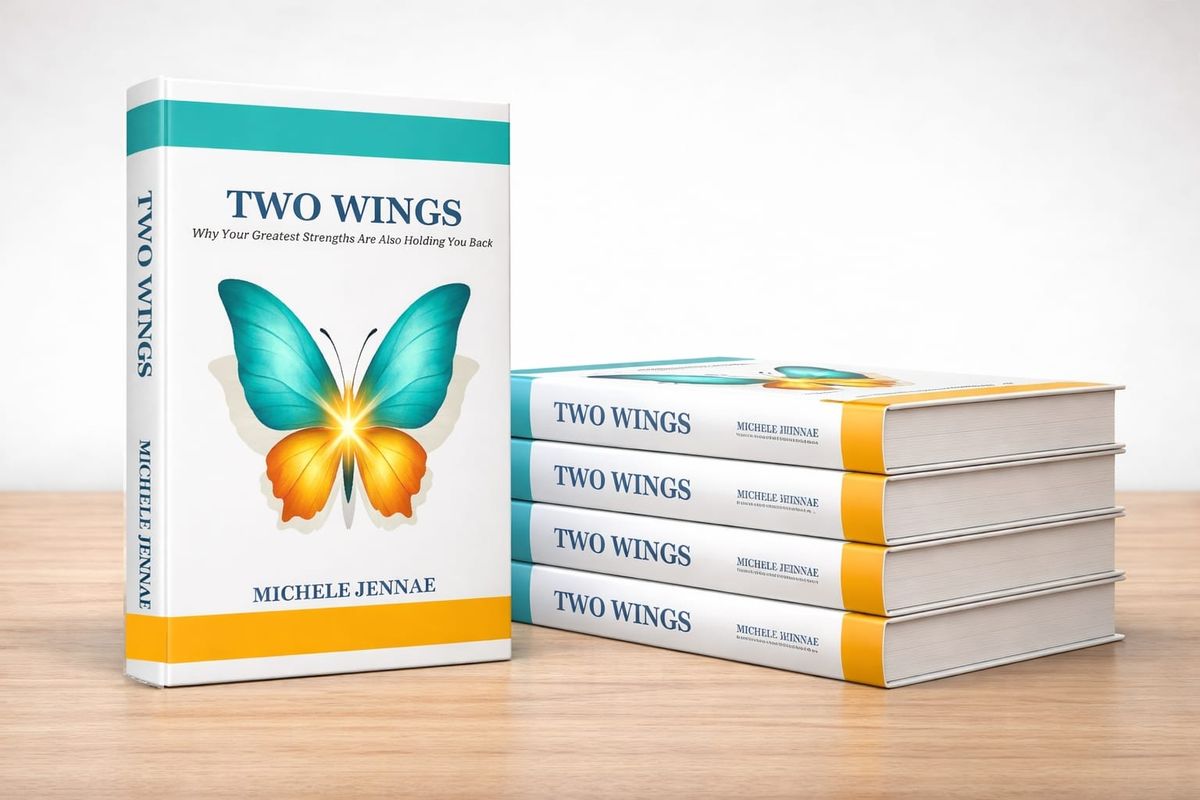
Get the Weekly Genius Update
Curated so your inbox is Genius too!










Member discussion